
The Art of Seeing Beauty
By Dr. Juris Bunkis
Honorary Consul, Republic of Latvia in Southern California
Orange County Plastic Surgery, Corona del Mar/Newport Beach
Dr. Ekstrom and I agree on a great many things—but art is certainly not one of them!
My art collection includes a number of European paintings from the 1700s and 1800s, along with works by early California artists from the late 1800s. I love them. I enjoy the craftsmanship, the history they represent, and even the elaborate old frames that have surrounded some of these paintings for generations.
Dr. Ekstrom sees things a little differently. Those heavy antique frames that I admire? She would gladly see many of them disappear! She finds all of my older paintings dark and foreboding. Take us to a museum and she is much more likely to head toward the modern galleries, while I will happily spend hours among works from the Renaissance through the nineteenth century.
Which one of us is right?
Both of us—or perhaps neither of us.
One of the wonderful things about art is that there really is no universal standard that determines what we must find beautiful. A painting that moves one person profoundly may leave another completely unmoved. Someone may stand before an abstract canvas and see energy, emotion and imagination, while the person beside them wonders what all the fuss is about. Another may be captivated by the technical mastery and history of a centuries-old portrait, while someone else simply sees a dark old painting in an even darker old frame!
The expression “beauty is in the eye of the beholder” has endured because it describes something very human. Our ideas of beauty are shaped by our experiences, memories, culture, personality and emotions. Art does not need unanimous approval to be successful. Sometimes its greatest value is simply in what it makes you feel.
Perhaps that is why visiting museums together is so much fun for us. Dr. Ekstrom may be drawn to something I would walk right past, and I may linger before something she would never consider hanging in our home. Neither reaction is wrong.
And despite our differences, we do share one important appreciation: beauty comes in many forms.
That same principle applies remarkably well to the human form—which brings us to Dr. Ekstrom’s topic this week.

Painting which Dr. Bunkis purchased in a gallery in Spain. It is by an unknown artist from Seville, Spain from the late 1700’s.

Dr. Bunkis purchased this painting by Katia Pissarro in a gallery in New Orleans some 20 years ago.

Painting that Dr. Bunkis first purchased about 40 years ago, by early California artist, Thomas Hill of Nevada Falls in Yosemite, in the 1880’s
The Human Body as a Work of Art
By Dr. Deborah Ekstrom
Orange County Plastic Surgery, Corona del Mar/Newport Beach
This Week's Plastic Surgery Quiz
Calf implants are most commonly positioned:
I often tell my patients that we are God’s walking art. And just as Dr. Bunkis and I can look at the same painting and have completely different reactions, there is no single body shape that everyone considers ideal.
Some people love long, slender legs. Others prefer calves that look fuller, shapelier or more muscular. In plastic surgery, what matters is not creating the body your surgeon finds most attractive. Our job is to understand your vision and your expectations and determine whether we can safely help you achieve them.
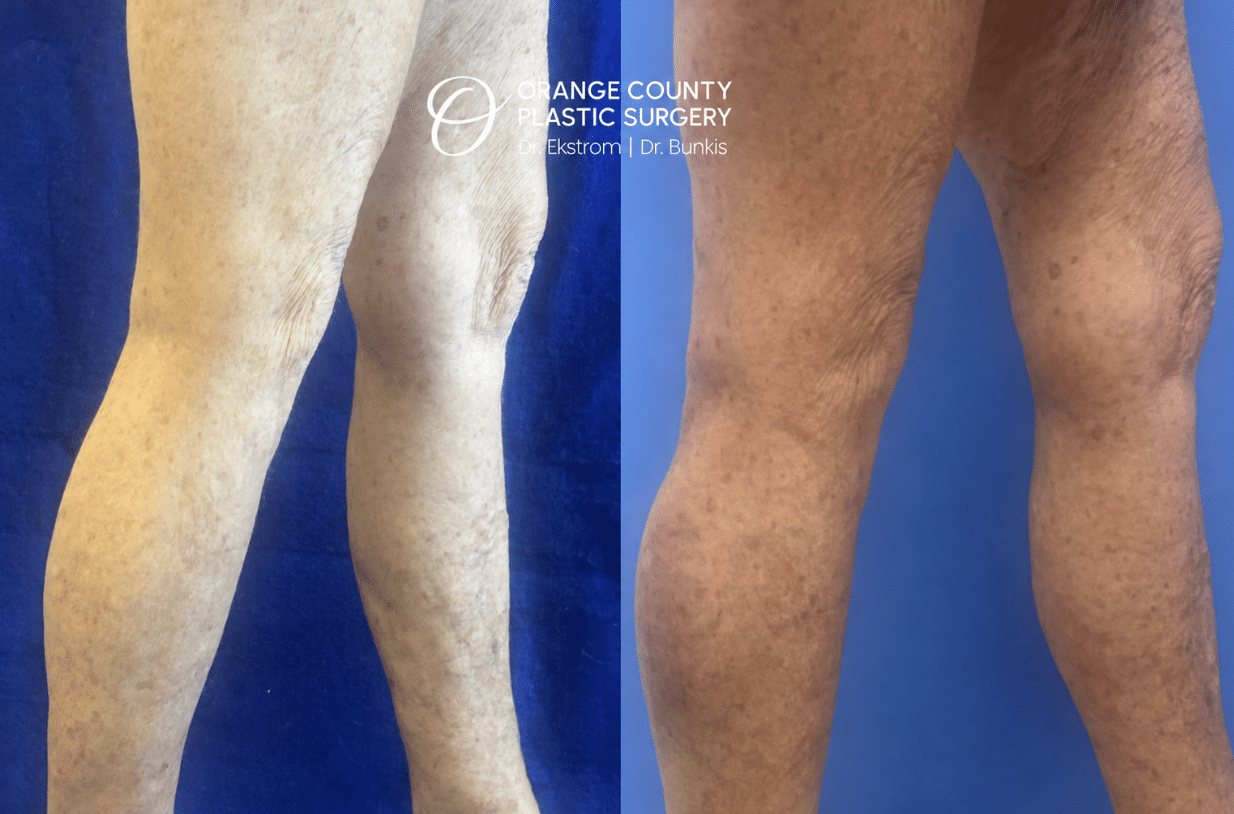
For patients bothered by disproportionately thin or poorly developed calves, one option is calf augmentation with implants. Orange County Plastic Surgery is one of the relatively few practices in the Newport Beach area performing body implant procedures including calf, buttock and pectoral augmentation.
Calf implants have been used for decades. They can provide cosmetic enhancement but historically have also been used to improve contour deficiencies resulting from congenital conditions, disease or injury – for example, we have put calf implants into patients unilaterally to correct asymmetries caused by polio of being born with a club foot on one side.
Planning begins with the patient standing so that the natural contours of the leg can be carefully marked. Depending upon the desired result, pockets can be designed over the medial and lateral heads of the gastrocnemius muscle. The medial implant is generally larger and extends farther down the calf, reflecting normal calf anatomy.
Under light general anesthesia, a transverse incision is made within the natural crease behind the knee. This location generally heals extremely well and can become quite inconspicuous. Using blunt dissection, a pocket is created over the appropriate muscle and the implant is carefully positioned.
Unlike breast implants, calf implants are made from soft, solid silicone elastomer. They do not contain a liquid or gel center and therefore are not subject to the same concerns about shell rupture or leakage. In the absence of a problem, they are not routinely replaced simply because a certain number of years has passed.
After the incisions are closed, a supportive bulky dressing is applied. We generally keep the knees slightly flexed during the first ten days to minimize tension on the incisions and give them the best opportunity to heal beautifully.
Whether we are discussing a Renaissance painting, a piece of modern art—or the contours of the human body—the lesson is much the same:
There isn’t just one definition of beauty. The most important eye of the beholder is your own.
This female in her early 70’s came in to see us about enhancing the contour of her legs. She told us that her thin legs have bothered her all of her life and she wished to have more muscular calves. She is shown here before and after bilateral calf augmentation surgery. This was a team surgery performed by Dr. Deborah Ekstrom and Dr. Juris Bunkis of Orange County Plastic Surgery in Corona del Mar/Newport Beach.
Interested in achieving your dreams? CLICK HERE to set up an appointment with Dr. Ekstrom to explore your options.

Orange County Plastic Surgery at CosmetiCare
1101 Bayside Drive, Suite 200
Corona del Mar, CA 92625
Take the elevator to the second floor (Suite 200) and check in with the front desk for your consultation or follow-up.
Free Parking Available.

